The customer has to re-tell their story.
Information from chat, phone, email, or portal does not carry over to the next touchpoint.

Improve customer journey and experience
A customer does not see separate departments or systems. They want to resolve a question, submit a change, or complete an application. Yet, they often have to start over as soon as the channel or team changes.
In short: CXM helps you understand, design, execute, and improve the entire customer journey, across channels and departments.
Discuss the customer journey that is currently stuck
A recognizable journey.
Even when the channel changes.
Does this sound familiar?
CXM becomes important when isolated improvements have little effect because the real problem lies between teams, channels, and process steps.
Information from chat, phone, email, or portal does not carry over to the next touchpoint.
The customer searches for information, switches channels, and re-enters data before anything can be completed.
Every step seems to perform well locally, while the total lead time and customer effort increase.
Messages use isolated characteristics but do not align with the customer's phase, need, or previous action.
In plain language
Customer Experience Management, or CXM, connects touchpoints, processes, data, and ownership around the customer's goal. This way, you don't improve an isolated page, but the experience from start to finish.
Customer Experience Management is how you design and improve the experience across the entire customer journey. This includes communication, service, self-service through digital channels, employees, processes, and systems.
We start with a concrete customer goal, such as reporting damage, changing a contract, or arranging a payment. Then we visualize where the customer experiences difficulty, where information is lost, and which internal dependencies slow down the journey.
A good customer journey is not only beautifully designed. Data, technology, work instructions, and ownership must also actually enable the desired experience. That is why we connect design and implementation from the start.
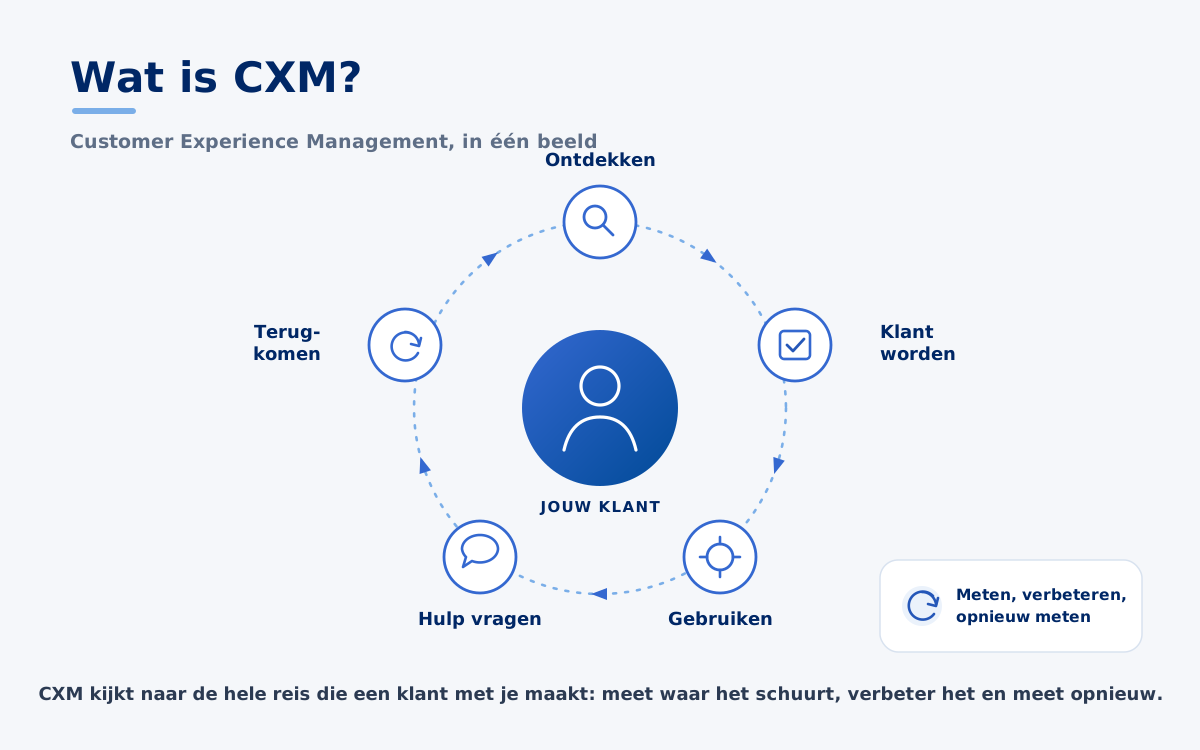
CXM in one image
The image shows how you view, measure, improve, and re-test the experience across all touchpoints from the customer's goal.
Our approach
We visualize the problem, choose the right improvement points, and translate the desired design into processes, data, and technology.
We map the current journey, customer questions, drop-offs, and internal bottlenecks, and determine where improvement has the most value.
We design how information, communication, and process steps come together across channels.
We implement the chosen steps, guide teams, and make results visible with data and customer feedback.
What we can achieve
The solution can start small at an important moment and be expanded later. We only choose components that contribute to the customer's goal.
Make visible the steps, expectations, and emotions the customer experiences from initiation to completion.
Investigate where customers search, wait, repeat, or stop and what the true cause is.
Make visible which teams, rules, data, and systems are needed behind the scenes for the customer journey.
Ensure that the website, portal, email, chat, and employees use the same context and explanation.
Use only data that helps make the next step easier, clearer, or more personal.
Establish who oversees the entire journey and on which customer and business outcomes teams jointly focus.
What it delivers
A better experience arises when the customer reaches their goal faster and the organization has less need to recover or transfer.
Less searching, repeating, waiting, and switching between channels.
Communication and service align with the customer's situation and previous steps.
Departments focus on the same journey and outcome instead of only on their own touchpoint.
A clear and simple experience reduces drop-offs and increases the likelihood of customers continuing.
Measurable results
We combine behavioral data, operational figures, and customer feedback to see where the overall journey becomes better or more difficult.
How much effort does the task require, and what percentage of customers complete it without unnecessary help?
How often does a customer need to re-contact or be transferred between teams and channels?
Does the journey become faster, and does the improvement contribute to retention, conversion, or lower service costs?

Case study
A concrete example shows how strategy, technology, and implementation together deliver results.
View the customer storyFrequently asked questions
Is your question not listed? Use the short form below. A subject matter expert will respond with a concrete first step.
Customer research provides insight. CXM uses that insight to actually improve communication, processes, data, technology, and ownership.
No. We usually start with an important customer goal or moment with high drop-off rates, contact volume, or business value.
CCM primarily focuses on what you send, such as letters and emails. CXM looks at the total experience and all touchpoints in the customer journey.
Yes. We translate the desired design into processes, content, data, technology, testing, and management, and remain involved until it works.
That depends on the journey. We start with available contact, process, and behavioral data, and only determine additional measurement that is truly necessary.
First step
Name a task or moment where customers often call, drop off, or have to start over. You will receive an initial substantive response within one business day.
Prefer to email directly? info@dialoggroup.eu
Search
Type at least two letters. You are searching all English pages.
Search results