The same text exists in multiple versions.
Teams manage similar passages in Word files, applications, and local templates, without clearly knowing which version is current.

Managing Customer Communication
Every change to a letter, invoice, or email often impacts multiple systems, teams, and vendors. As a result, a small adjustment can take weeks, and old versions remain in use longer than desired.
In short: CCM helps you centrally compose, manage, approve, and send customer messages through the right channel.
Discuss your biggest communication bottleneck
A change in one place.
Consistent across every channel.
Do you recognize this?
CCM becomes relevant when volume, regulations, and personalization grow, while the current way of working remains based on disparate templates and system dependencies.
Teams manage similar passages in Word files, applications, and local templates, without clearly knowing which version is current.
A text adjustment requires IT, a vendor, testing, and multiple approvals, even if the content is simple.
Employees copy information, check for exceptions, and correct errors before a message can be sent.
A letter, email, and portal message use different texts or data, leading to customers receiving contradictory information.
In plain language
Customer Communication Management, or CCM for short, brings together content, rules, customer data, and delivery. This way, you make communication personal and consistent, without managing each message separately.
Customer Communication Management is the combination of software, content, data, rules, and working agreements that allows you to create and send large numbers of customer messages. Think of letters, emails, invoices, policies, overviews, and other documents.
Instead of managing complete messages in many places, you work with approved content blocks, templates, and decision rules. Customer data determines which information is relevant and through which channel the message is offered.
A good CCM setup is not just about a platform. Ownership, editing, approval, testing, archiving, and management must also be clear. We connect these components into a methodology that continues to work in practice.
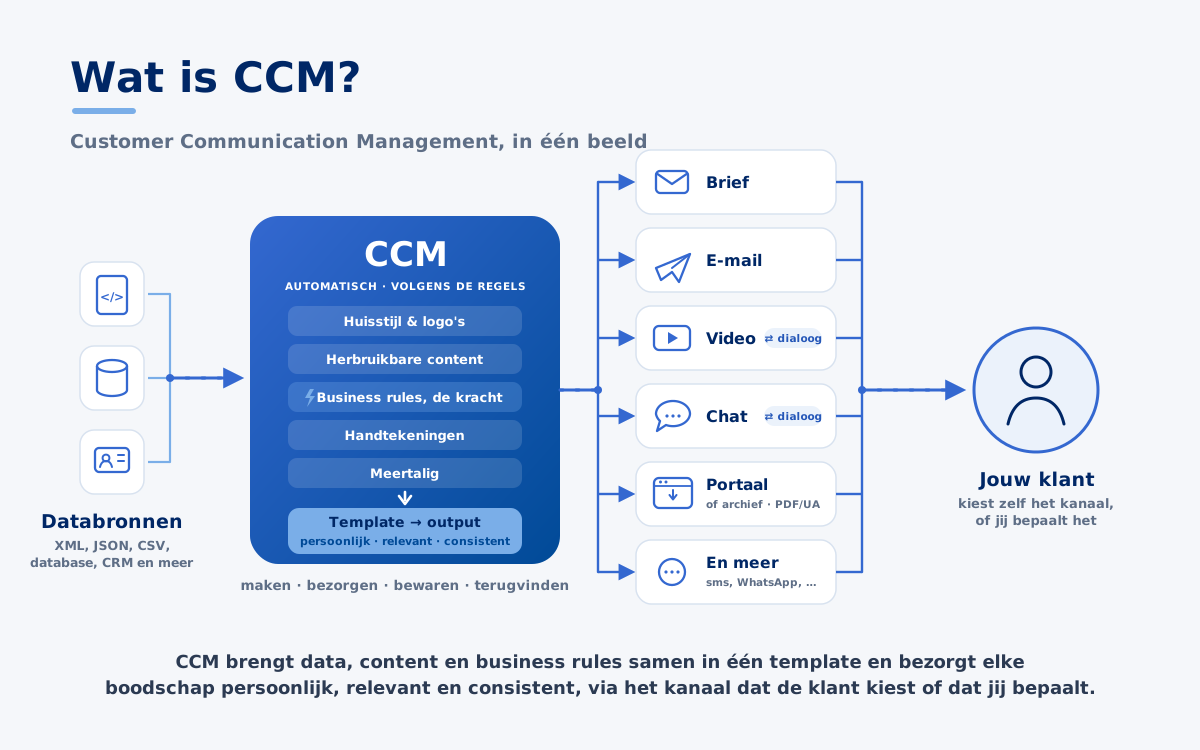
CCM in one image
The image shows how data, corporate identity, content, and rules come together in one manageable communication flow to the customer's channel.
Our approach
We don't just improve the production line. We ensure that content, data, processes, and ownership together form a reliable foundation.
We examine communication flows, variants, volumes, risks, and how changes currently move through the organization.
We create a scalable model for templates, reusable content, rules, data, and channels, and connect it with your existing environment.
We build in phases, test with real-world scenarios, and ensure that teams can safely implement changes after go-live.
What we can achieve
The components vary by organization. We choose what is needed to achieve the desired customer value, speed, and manageability.
Manage fixed texts, conditions, explanations, and corporate identity elements in a central location.
Let rules and customer data determine which components, amounts, terms, and next steps are included in a message.
Use the same reliable foundation for print, email, portal, archive, and other digital outputs.
Make visible who made a change, which version was approved, and when it was used.
Connect the customer information system, also known as CRM, with policy, billing, document management, archive, and sending services without unnecessary duplicate data.
Track production, errors, drop-offs, and customer reactions so that communication can be refined purposefully.
What it delivers
CCM delivers value when employees can make changes faster and customers receive the same clear information, regardless of the channel.
Approved content and rules are used consistently across different messages and channels.
Content teams can make more adjustments themselves without starting a technical project for every text change.
Composition, checks, and sending are automated where it is safe and sensible.
Versions, approvals, data used, and sent output are more transparent and controllable.
Measurable result
Not the number of migrated templates, but the improvement in speed, quality, and customer behavior determines the result.
How quickly can a content, legal, or commercial adjustment be safely implemented?
How many messages require manual correction, re-production, or additional verification?
Does the message lead to understanding and the desired action, or does it create additional questions and drop-offs?

Case study
A concrete example shows how strategy, technology, and execution together deliver results.
View the customer storyFrequently asked questions
Is your question not listed? Use the short form below. A subject matter expert will respond with a concrete first step.
CCM encompasses how you compose, manage, approve, and send letters, emails, invoices, policies, and other customer documents.
No. A phased approach is usually better. We start with communication that has high volume, risk, manual work, or customer impact.
Often, yes. We first identify the required data, actions, and outputs, and then design suitable integrations.
That is often an important goal. We set up roles, permissions, and approval processes so that content changes can be made faster without losing control.
By co-designing content models, ownership, standards, testing agreements, and management from the start.
First step
Name a message stream where a lot of manual work, delay, or errors occur. You will receive an initial substantive response within one business day.
Prefer to email directly? info@dialoggroup.eu
Search
Type at least two letters. You are searching all English pages.
Search results