
Customer Communication (CCM) Explained

What is Customer Communication Management?CCM in Plain English.

Customer Communication Management, or CCM for short, is the way you create, manage, and send large volumes of letters, emails, invoices, and documents.

Practical ExplanationDialog Group6 min read
Colleagues collaboratively reviewing content and customer data on a screen

The Core

Why this topicdemands attention now.

CCM brings together content, customer data, rules, approvals, and channels. This way, the same text doesn't need to be maintained separately in many places.

A good approach doesn't start with a standalone tool. First, it must be clear what problem the customer is experiencing, what outcome the organization wants to achieve, and which processes, data, and people are involved.
At a glance

CCM in one overview.

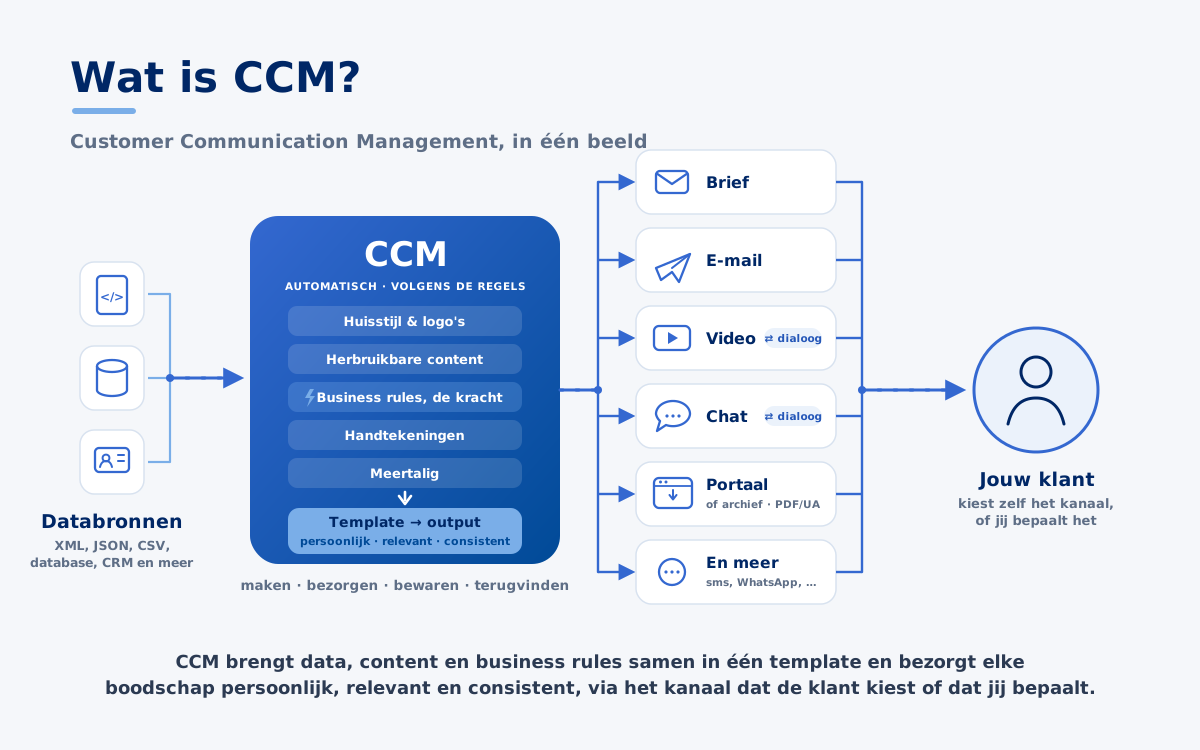
Use the diagram as a summary. The components are explained further in plain language below the image.

Diagram of CCM: data sources, content, rules, and channels converge into personalized customer communication.
CCM connects data sources, content, rules, and channels into a single manageable flow to the customer.

Important to know

Four points that helpmake better choices.

These components provide a concise overview of the content. Use them as a starting point for a conversation between business, IT, customer service, and compliance.

Content

Approved text blocks and templates are centrally managed.

Data

Customer data determines which information is relevant.

Rules

Decision rules select variant, channel, and timing.

Control

Versions, approval, and dispatch are more transparent.

A professional uses clear explanations to determine a next step.
From insight to execution.The solution emerges when content, process, data, and ownership are designed together.

Practical Approach

Start small and focused.Build on what demonstrably works.

You don't have to solve everything at once. These three steps make the topic discussable and actionable.

  1. Map out communication

    Look at volume, errors, manual work, legal changes, and customer inquiries.

  2. Choose an initial stream

    Start with communication that holds high value or risk.

  3. Set up management

    Define roles, testing, publication, and continuous improvement.

What it can yield

Not just knowledge.A better next step.

CCM helps make communication clearer and more consistent and reduces the time teams spend on changes and remediation.

Read the full CCM page

Next step

What do you want to achievein your organization with this?

Briefly share your question. You will receive an initial substantive response within one business day.

  • No obligations
  • Direct contact with a specialist
  • A concrete initial thought direction

We only use your data to respond to your inquiry. Read our privacy statement.